Lucky me

I saw Lucky Guy last night, and it reminded me how much I loved newspapering. Every day was a new day. The quiet ones were the worst. But even then, you knew the phone could ring any second and change everything.

I got a 1 a.m. call that Billy had referred to Reggie and George with the immortal words, “One’s a born liar, the other’s convicted.” I was there when the managing editor, Vinnie Musetto, told the metropolitan editor, Marc Kalech, that the Challenger launch would get 12 inches or so on Page 13, “and let me know if it crashes.” I was there for Headless Body in Topless Bar.

I inhaled way too much second-hand smoke and saw way too many reporters perform miracles under the influence of way too much alcohol. But the competition between The Post and The Daily News was thrilling.

I was night sports editor at The Post when McAlary and Drury were reporters, and I did not know how much both wanted to cover the city. McAlary wanted to be Breslin. Drury wanted to be Hunter Thompson.

McAlary came much closer. So happy that he won the Pulitzer, so sad that he died so young.

They were great days, and they’re gone now. But I was there when they were great, and nobody can take that away from me.

Not gonna work

Image

AT&T to Introduce Solar-Powered Charging Stations. (New York Times)

Starting Tuesday, 25 solar-powered charging stations will sprout in parks, beaches and other outdoor spaces in the five boroughs, part of a pilot project from the wireless provider in partnership with the city. The stations — 12.5-foot steel poles with three petal-shaped solar panels fanning out on top — can accommodate up to six devices at a time regardless of wireless carrier, with dedicated ports for iPhones, Androids, BlackBerrys and standard USB charging cables.

A very cool idea. But seriously, folks . . .

Who’s going to stand around this charger cocktail table in the middle of the beach at Coney Island for half an hour waiting to get a 30 percent charge on his iPhone? Or even worse . . . standing around for two hours in Bryant Park waiting for a full charge?

I suppose we could leave our phones there and go for a cup of . . . no we can’t. This is New York. Chances of finding the iPhone where you left it are about as good as the Mets coming back to win the World Series this year.

Not to mention what’s going to happen when a hundred people want to use the same recharge stand. This isn’t London; we don’t queue up in an orderly manner.

I don’t have high hopes for this one.

Messing with the masters

You don’t mess with the master. Don’t even think about singing “Respect.” Aretha did it, and you’ll only do it worse. “My Girl”? Forget about it. The Temptations did it; your effort won’t compare. “Over the Rainbow”? Not even The Genius himself, Ray Charles, could match Judy Garland.

But once in a while, someone pulls it off. Ray gave us a perfect song, “Georgia on My Mind.” Put it on a loop. Let it play forever. But Willie Nelson’s version is worthy of comparison. Sometimes, if you’re brilliant — and Willie is brilliant — you can take a perfect song and still make it yours.

Last night, on “The Voice,” the four judges — Shakira, Adam Levine, Blake Shelton and Usher — tackled Lennon-McCartney’s “A Little Help From My Friends.”

And they killed it. Hit it right out of the park.

But here’s what struck me . . .

“A Little Help From My Friends” is a pop song, a cute little ditty from the Beatles’ Sgt. Pepper’s Album.

It’s a wonderful song, from possibly the greatest album of all time. But it’s not the defining version of the song. The defining version, the one against which you match all challengers, was done by Joe Cocker.

The first time we heard Cocker’s version, it spun our heads around. Cocker took on the master, and he slayed him. THIS was how it should be done. Cocker took a song from Sgt. Pepper’s and he made it his. If you want to mess with the master, you mess with Cocker — not the Beatles — on this one.

So kudos to the Voice judges for doing it right, and kudos to Joe Cocker for showing us all how a great song by the greatest group of all time can be done even greater.

And happy 71st birthday to Paul McCartney. Only wish John and George were around to help you celebrate.

Paul+McCartney

Ike

Image

My first real-world boss was Ike Gellis, the legendary sports editor of the New York Post. How I got the job is told in this post. How I kept it will never cease to amaze me.

Ike sat behind a large wood desk in the middle of the sports department, a filthy room in a decrepit fortress of a building on South Street. He was lord of the room, able to see everything, hear everything.

Ike was described in Pete Hamill’s book, A Drinking Life, as “the world’s shortest Jew.” And he very well may have been. He stood about 4-11 in heels. That’s him at the top, in the center, his feet way off the ground, decades before we crossed paths. Ike was much older — and shorter — by the time I met him. (The Post’s longtime and hugely respected executive editor, Paul Sann, is on the right.)

There was a man named “Iggy” in the mailroom down the hall. He would stand on a stool so he could see through the window that separated his room from anyone coming to pick up or mail a letter. That’s because Iggy was a dwarf. Or as we say these days, a “little person.” He was also the only person in the building who was shorter than Ike. He’d stroll into the sports department now and then . . . and Ike would immediately get out of his chair. We’d all fight our best to suppress falling on the floor in gales of laughter. Iggy walks in, Ike stands up. He sure loved being taller than someone.

I held the lofty title of Sports Editorial Clerk, which meant I was a copy boy who could type a bit. When Ike’s glasses were dirty, he’d hand them to me to run to the bathroom and clean them. When Ike wanted to place a bet with the bookie downstairs, I was the one who went down and placed it. When he invited his friends in the building into the sports department to share some Isaac Gellis kosher hot dogs (yeah, he had a background in kosher meats), I was the one who got to clean out the pan Ike cooked them in. And no, I never got to eat a dog.

One of my assigned daily tasks was to compile the Sports on the Air, the listing of what sports were on TV and radio. It was a very serious job. I had to call all the stations and go through large piles of mail daily to collect all the information, and then make sure I got it right in the paper. Get the starting time of the Knicks game wrong, and all hell would break loose.

Here’s what you need to know about Ike. He was a New Yorker through and through. I think he traveled north of 86th Street only for Yankee games. He thought Yonkers Raceway was upstate. He thought Albany was in Manitoba. And TV was in New York, and that was all there was to it.

One day in late January, Ike was reading the Boston Globe. He looked at the Globe’s sports listings and discovered that the Super Bowl was going to air on Channel 7. But it said right there in the New York Post that it was on Channel 4. Clearly, somebody was wrong. And clearly, it was me.

“Hey Geronimo,” he said, motioning me over. “How come it says in the Boston Globe that the game is on Channel 7 and we say it’s on Channel 4?”

I explained that the NBC affiliate in Boston airs on Channel 7, and that the NBC affiliate in New York airs on Channel 4. This, of course, made no sense whatsoever to my boss.

“Better check it out,” he said.

And he watches as I walk back to my desk and ponder my next move. Do I call the top sports guy at NBC, with whom I spoke regularly, and ask if NBC is planning to air the Super Bowl on Channel 4 in New York? Ike is watching. He’s waiting for me to pick up the phone.

Here’s to Sid Friedlander, assistant sports editor, who took pity on me and ambled over to Ike to explain that NBC would, in fact, air the game on Channel 7 in Boston and Channel 4 in New York. It’s kind of how TV works, Sid told Ike.

Ike didn’t quite understand it, but he could accept it because Sid said it was so. No way he was going to believe me.
Springsteen of the nerds

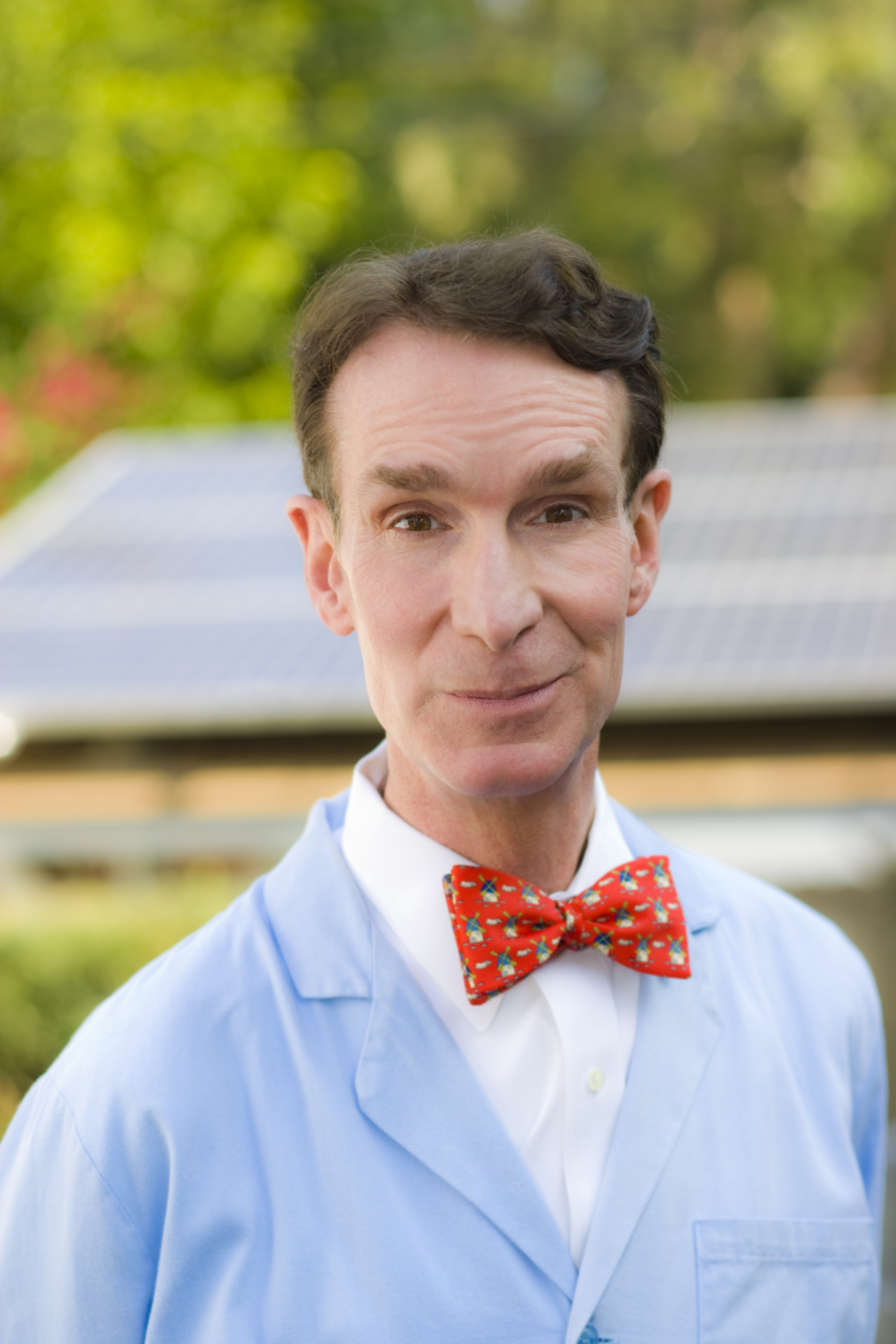
Portraits of Bill Nye at his home in Studio City, California.

“If you want to deny evolution and live in your world — in your world that’s completely inconsistent with everything we observe in the universe — that’s fine. But don’t make your kids do it, because we need them. We need scientifically literate voters and taxpayers for the future.”

So says Bill Nye, the Science Guy, quoted in this wonderful piece in the New York Times. The writer, John Schwartz, calls him “Springsteen of the nerds.” I love that almost as much as I love Nye, an American hero who is not afraid to tell truth to power.

When science contradicts your religion, try to reconcile one with the other. The science is fact. Your religion shapes who you are, but it does not allow you to deny scientific fact.

Time for some diversity. Or not.

“Letters From Dad” are a routine read on Father’s Day. You round up a few dads, ask them to pen letters to their kids, and you publish them so that readers can nod and think yeah, that’s what fatherhood is all about. The most important thing I’ll ever do and I’m so proud of you and you’re the best thing I’ve ever done and it’s the greatest role I’ll ever play and blah blah blah.

And you know people will read the “letters from Dad,” because they’re the ultimate Father’s Day feelgood.

So wouldn’t you think Time Magazine’s editors would know there are some black dads capable of putting their thoughts into words?

Maybe not, as Mediaite noticed today.

What a dumb omission. Not too smart, Time.

Must read 06/17/13

State photo-ID databases become troves for police. (Washington Post)

In many ways, this is much more disconcerting than the NSA data-mining “scandal.” Top of the website this morning:

The faces of more than 120 million people are in searchable photo databases that state officials assembled to prevent driver’s-license fraud but that increasingly are used by police to identify suspects, accomplices and even innocent bystanders in a wide range of criminal investigations….

The most widely used systems were honed on the battlefields of Afghanistan and Iraq as soldiers sought to identify insurgents. The increasingly widespread deployment of the technology in the United States has helped police find murderers, bank robbers and drug dealers, many of whom leave behind images on surveillance videos or social-media sites that can be compared against official photo databases.

But law enforcement use of such facial searches is blurring the traditional boundaries between criminal and non-criminal databases, putting images of people never arrested in what amount to perpetual digital lineups. The most advanced systems allow police to run searches from laptop computers in their patrol cars and offer access to the FBI and other federal authorities.

__________

Study finds supportive tilt to gay marriage coverage. (New York Times)

Tough call here. The piece points out:

The study lends credence to conservative charges that the nation’s news media have championed the issue of same-sex marriage at the expense of objectivity. Others have argued that news organizations are right not to overly emphasize opposition to what many see as a core civil rights issue.

And that’s what makes it a tough call. Would news coverage that tilted toward legalizing interracial marriage have been wrong? What about news coverage that tilted toward freeing slaves? We strive for fairness and balance, but does every issue require that each side get equal time?

__________

Ohio police chief takes criminals to task online. (AP)

49,000 is about to multiply exponentially. What a fun story. Don’t be a mope:

KENT, Ohio (AP) — If you’re up to no good in this pocket of northeast Ohio, especially in a witless way, you’re risking not only jail time or a fine but a swifter repercussion with a much larger audience: You’re in for a social media scolding from police Chief David Oliver and some of his small department’s 49,000 Facebook fans.

__________

Bloomberg plan aims to require food composting. (New York Times)

I’m sure the right will blast this as nanny-statism, and it’s seriously hard to imagine pulling this off in New York City, but . . . It really is a great idea. It will save money and it’s environmentally sound.

If composting can make it here, it can make it anywhere. It’s up to you, New York.

Must read 06/16/13

Gail Collins’ column, The Other Side of the Story, in Saturday’s New York Times is on the essential reading list. If you’re not concerned about the possible effects of data mining, just read about Brandon Mayfield. It’s a chilling story, and worth remembering. Bookmark this one and reread it every now and then.

An AP story on FOXNews.com has a Methodist minister opposing license plates that feature an “iconic image of a young Apache warrior shooting an arrow skyward [that is] depicted in Allen Houser’s “Sacred Rain Arrow” statue [and] was a clear choice of a public that looked at more than 40 designs that featured Native American art, cowboy images and western and wildlife themes.”

Tourism officials hailed the license plate as a traveling billboard for Oklahoma, and the image was deemed the best license plate in the nation in 2009 by the American License Plate Collectors Association.

But a Methodist minister claims the plate is an affront to his Christian beliefs, and a federal appeals court ruled last week that the minister’s case can proceed.

“I think it’s important to understand that whether it was a Native American symbol or a symbol of any other faith, the issue would be the same,” said Keith Cressman, pastor at the St. Marks United Methodist Church in Bethany.

It pains me to say this, but the minister is right. If the image depicts a prayer, it does not belong on a license plate.

And finally, Mo Elleithee offers this on Salon: To my daughter on Father’s Day: Sorry I used to be a sexist. 

I never had a daughter, but I like to think I’d be writing this to her if I had.